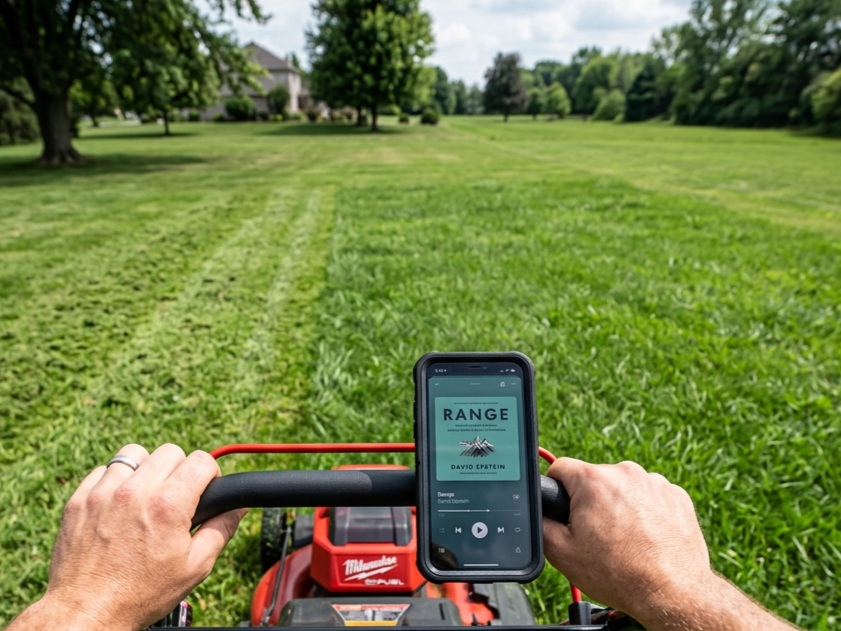
I usually listen to nonfiction audiobooks from Audible while I’m mowing the lawn or doing yard work. It takes the edge off the labor, gives my hands something to do while my mind stays engaged, and I’ve found myself looking forward to it more than I expected. It feels like time well spent, even if the grass still needs cutting either way.
Over the past couple of weeks, I’ve been listening to Range: Why Generalists Triumph in a Specialized World by David Epstein. I’m finishing the afterword now, and I’ve come back to the same thought more than once. This feels familiar in a way I didn’t expect.
Not because I’ve lived the examples, especially the stories rooted in athletics and the arts. I haven’t. But the pattern he describes, the way people find their footing over time, lines up with what I’ve seen in my own work.
There’s a version of success most of us absorb early on. What do you want to be when you grow up? Pick a lane, commit, stay focused. It’s a clean story, and it works in some domains. But much of the work most of us actually do doesn’t behave that way. The environments I’ve worked in have been harder to define. The rules shift. Feedback isn’t always clear. Problems evolve while you’re still trying to understand them.
Epstein also touches on the feeling of having fallen behind if you didn’t start early or follow a clear plan. That part resonated. When I left the Navy, I remember working alongside people my age who seemed much further along in their careers. They had already specialized. They had titles that implied a trajectory. I didn’t see that same shape in my own path yet. It took time to understand that being on a different timeline isn’t the same thing as being behind.
Looking back, my own path doesn’t map cleanly to a plan. Navy nuclear power, recruiting, technical writing, development, marketing, executive communications, and now an interest in program management. There are threads, but it’s not linear. For a long time I wasn’t sure how to talk about that. It felt indirect.
What Range helped me see is that the value isn’t the variety for its own sake. It’s what that variety enables. The ability to connect ideas across domains. To take something that made sense in one context and apply it in another. To recognize patterns that aren’t obvious when you’re deep inside a single discipline.
That’s part of why the book also resonated with some exec comms consulting I’ve done for Microsoft Discovery. The body of human knowledge keeps expanding, but it doesn’t expand evenly. It fragments as fields go deeper and more specialized. Discovery, at least as I’ve come to understand it, is one response to that reality. It’s not just about bridging gaps between disciplines, though that’s part of it. It’s about making it possible to reason across a growing, disconnected body of knowledge. Helping people move from ideas to outcomes by working across data, models, and domains that don’t naturally align. In that sense, it’s less about replacing specialization and more about making it workable at scale.
That way of thinking shows up in how I work. In the Navy, qualifying for nuclear power watchstations required learning systems end to end: why components exist, how they’re arranged, how they interact, and what changes cascade through the system. Most of it isn’t visible. You rely on instrumentation, expected outcomes, and quick diagnosis when something doesn’t behave. I still build those mental models now, whether it’s software, publishing platforms, or an org trying to move forward without a clean playbook.
It’s tempting to read a book like Range as validation of a non-linear path. I caught myself doing that several times. When something lines up with your experience, it’s easy to emphasize the parts that confirm it and overlook the rest. That is confirmation bias at work. The story isn’t that clean. Some of this is pattern recognition after the fact. Some of it is timing and opportunity.
What I took from it is more practical. Breadth has value, but only if you use it. The work that seems to matter most is still the same. Make sense of ambiguity. Connect the dots. Help move something forward that doesn’t yet have a clear shape.
It’s a direction I want to keep leaning into, especially where connecting the work matters as much as the work itself.